Sometime during your life, you’ve probably seen that colorful triangle containing a variety of foods and how many servings you need to eat each day. Perhaps you learned about it back in health class, saw it displayed on the cafeteria wall, or glanced at it on the back of your cereal box one morning. That familiar food pyramid (introduced in 1991) was supposed to be our nutrition survival guide in a one-size-fits-all world. But let's face it—many people found the pyramid to be confusing, and felt that it didn't really help individuals know how to plan a healthy diet, one meal at a time. And maybe more importantly, nutrition (and how many servings of food you need each day) is far from one-size-fits-all.
So in May 2011, the USDA finally ditched the pyramid concept in favor of a brand new shape: a circle—or rather, a plate. Their former "MyPyramid" website was also revamped and now redirects to a new online tool: www.ChooseMyPlate.gov.
2005 Food Guide Pyramid
.jpg) |
New "MyPlate" Icon
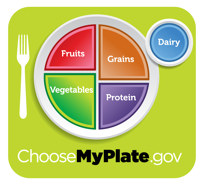 |
Pyramid vs. Plate: What's different?
While the basic nutritional guidelines for Americans remain the same, the USDA Plate and the old pyramid do have a few noticeable differences:
-
Less emphasis on grains. The food pyramid was dominated by grains, which filled in the largest spot at the bottom of the pyramid in the original version, and the large orange vertical bar in the 2005 version. The Plate version reserves only one quadrant for grains (with an emphasis on whole grains) and really focused on fruits and vegetables, which take up half the plate—more than any other food group. Many nutrition experts see this as a major improvement since Americans tend to fall short of reaching their minimum 5-a-day requirements. If half of the food you ate at each meal was comprised of vegetables and fruits, you'd have no problem reaching 5-9 servings of fresh, frozen, cooked or canned produce each day.
-
No mention of fats and oils (or sugars for that matter). These appeared on the old pyramid, shown in small quantities with the message to eat these foods rarely or in small amounts. These don't show up anywhere on the Plate, despite the fact that not all fats are created equal and that dietary fat is essential to optimal health. One could assume that the foods you include on your plate are going to contain fat, or be prepared in some source of fat, but the fact that it's not mentioned at all as part of a healthy diet may seem questionable—especially when Americans tend to consume too much of the wrong kinds of fats. Don’t despair, a quick click to the ChooseMyPlate.gov site provides in-depth information about fats, oils and added sugars.
-
Bye, bye serving sizes. Not only did the food guide pyramid tell you how many servings of each food group to consume each day (such as 6-11 servings of grains), but it somewhat alluded to how large a single serving actually was. The Plate does not depict or mention how many servings you should eat of any particular food group, nor how big a serving actually is. Many nutrition professionals have been using a plate method similar to this to educate clients for years. The assumption is that if you eat off of a normal sized plate (nine inches in diameter or smaller), and if you don't pile your food up too high, you're eating a normal, healthy amount for weight management. In a sense, the lack of serving sizes makes the Plate simpler to implement and understand than the pyramid once was. And for more specific amounts of foods needed for children, teens, adults (even during pregnancy and breastfeeding), the ChooseMyPlate.gov site allows you to enter your personal data and get an individualized eating plan.
-
Where's the beef? While the pyramid featured food groups, the plate mixes in one other element: nutrients. At least as far as protein is concerned. Protein is a nutrient found in various foods, not an actual food group, which has left some people perplexed. Fruits (food), vegetables (food), grains (food), and milk (food) are all represented, but protein (nutrient) seems out of place. The USDA says that in their test groups, Americans of all racial and ethnic backgrounds understood what "protein" meant: a variety of sources (meat, eggs, dairy, nuts, seeds, beans, soy, etc.). Some critics say that protein is found in many foods already listed on the Plate, such as grains, milk and even vegetables, and that this might confuse consumers. Other critics of this approach feel that Americans will only think of "meat" when they hear the word protein, even though plant-based proteins are also healthful and should be included in one's diet. Most likely, simplifying the once tongue-twisting name (the meat, beans, nuts, and legumes food group) into "protein" was just easier when designing this graphic. After all, simplicity and ease of understanding is the main goal of the Plate.
Although no single image can possibly convey all the complexities of nutrition and healthy eating, many see the Plate as an improvement over the pyramid of our past. According to the USDA and other food experts, the simple Plate icon is easier to understand. You can look at it once and easily remember what it conveys, and which food groups it includes. Most people couldn't say the same about the complexity of the food pyramid.
Both the American Heart Association and the Academy of Nutrition and Dietetics (formerly the American Dietetic Association) endorse and support the USDA Plate icon. And SparkPeople Registered Dietitian Becky Hand says that she is thrilled with this new nutrition icon. "Folks can hang the Choose My Plate symbol on their refrigerator as an easy guide to use when planning a meal," she says. "If your dinner plate matches up with the four quadrants and one circle, then you’ll have a great start to a balanced and nutrient-filled meal!"
SparkPeople has always encouraged a balanced diet, including a simple plate method for portion control (found in Dietitian Becky's article "The Bikini Diet" from 2003). We encourage the intake of fruits and vegetables and are happy to see them emphasized so prominently on the Plate. Using a divided 9-inch plate as a way to encourage a variety of foods consumed in the correct amounts is a perfect way to improve one’s diet and reap health benefits.
Dissecting the Plate
Here's a rundown of the basic messages that go along with the Plate, and how SparkPeople's food philosophy fits into them.
.jpg)
The plate features five food groupings, each represented by their own color. The largest area is vegetables, followed by grains. Dairy is offset to the side of the plate, but if you choose not to eat or drink dairy products, the ChooseMyPlate.gov website also lists calcium-fortified soy milk to be nutritionally equivalent in place of milk.
In addition to the Plate graphic itself, the new icon is accompanied by the following nutritional guidelines that offer more information for healthy eating.
-
"Enjoy your food, but eat less."
Amen! SparkPeople believes that eating healthy should be enjoyable, so it's nice to see this point emphasized. Yes, most Americans could stand to eat less, and if you fill this plate just once per meal, you'll probably be on your way to balancing your calorie intake. Hand estimates that if you filled your 9-inch plate following the format, and used lower fat foods and cooking techniques, you would consume about 500-600 calories for the meal.
-
"Avoid oversized portions."
This is no small feat when so many people dine out or rely on convenience foods these days. Although the Plate doesn't talk much about portion sizes, SparkPeople recommends basic portion control, and tactics like measuring and weighing foods for accurate nutrition intake. This is especially important for weight control.
-
"Make half your plate fruits and vegetables."
This is an important point. Not only are fruits and vegetables bursting with good-for-you nutrients, but they are also low in calories and high in filling power, which means they can help with weight management. Need more tips to reach this goal? Start here.
-
"Make at least half your grains whole grains."
SparkPeople has always emphasized the importance of whole grains—and the fact that we need more. Whole grains are more nutritious and filling, and also pack fiber, which has a multitude of health benefits. However, many food manufacturers will try to trick you into thinking their product contains whole grains when it actually has little to none. Reading labels is key! Here's how to ensure the grains you eat are whole—and not masquerading as healthy.
-
"Switch to fat-free or low-fat (1%) milk."
If you are a milk drinker (or a cheese or yogurt connoisseur), consider switching to fat-free or low-fat dairy. The reason? Most people don't need the extra saturated fat and calories that come from higher-fat versions of dairy, and the low fat stuff has just as much protein, calcium and other nutrients, so it makes sense to switch. Try weaning yourself slowly down to skim rather than making the jump all at once.
-
"Compare sodium in foods like soup, bread and frozen meals—and choose the foods with lower numbers."
Most Americans consume dangerously high levels of sodium, but soups, breads and frozen meals are hardly the only culprits. Be on the lookout for other snack foods and processed foods—as well as restaurant dishes, which are all notoriously high in sodium.
-
"Drink water instead of sugary drinks."
If you've been a SparkPeople member for a long time, then you know how much we love water. We stand by our 8-cups-a-day recommendation, and always have. Here's why. Water is truly the only beverage your body needs, and by replacing other high-cal drinks with H20, you'll save tons of calories, sugar, and even fat from your daily diet.
Don’t worry if your favorite meals don’t fit exactly onto the new Plate. Many of the dishes we eat are combinations foods such as soups, stews, casseroles, pizza, stir fries, and burritos. "These foods will require a little dissection," states Hand. While it can be hard to determine the exact portion size of each food group within a meal like a casserole or burrito (as it related to the Plate), simply do your best. The USDA doesn't currently offer guidelines to help Americans dissect their combination meals, but we expect more tips to come in this area very soon.
"Now it is your turn to start planning," suggests Hand. "Is half your plate filled with fruits and veggies? Are you getting at least three servings of whole-grain foods daily? Take a peek in your pantry. Are there foods from every food group available for meal planning? If not, then get out paper and a pencil and start creating a grocery list."
Going out for dinner tonight? Can you put together a meal that includes all the foods in the right amounts from the restaurant menu? Get your children involved in the meal planning adventure, and don’t be surprised when you hear, "Hey, the vegetables are missing from my plate.” Now that will be music to your ears!
Food pyramid and Plate images courtesy of the United States Department of Agriculture (USDA) and ChooseMyPlate.gov. The USDA does not endorse any products, services, or organizations.
Sources
American Dietetic Association. "New MyPlate Is a Useful Tool for Consumers to Follow Dietary Guidelines and Eat Healthfully, Says American Dietetic Association," accessed June 2011. www.eatright.org.
American Heart Association. "American Heart Association CEO Nancy Brown Says New USDA Food Icon Is A Positive Step Towards Improving Consumer Health," accessed June 2011. www.prnewswire.com.
Hellmich, Nanci. "USDA Serves Nutrition Guidelines on 'My Plate'," accessed June 2011. www.usatoday.com.
The Journal of the American Medical Association. "New Nutritional Icon Steps Up to the Plate," accessed June 2011. www.newsatjama.jama.com.
Khan, Amina . "USDA to Reshape How We See Dietary Nutrition," accessed June 2011. www.latimes.com.
Neuman, William. "Nutrition Plate Unveiled, Replacing Food Pyramid," accessed June 2011. www.nytimes.com.
United States Department of Agriculture. "USDA's MyPlate," accessed June 2011. www.choosemyplate.gov.
Vastag, Brian. "At USDA, a Plate Usurps the Food Pyramid," accessed June 2011. www.washingtonpost.com.
|

