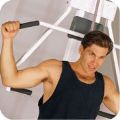
Navigating your way around the weight room can sometimes feel like an obstacle course—especially if you are not familiar with the surroundings. You can easily injure yourself if you're not being careful or attentive. In probably the largest study ever performed on weight room injuries, University of Arkansas researchers looked at weight-training injuries over a 20-year period and found that:
- The body parts most often injured in the weight room were the hands (23 percent of injuries) and the upper trunk (18 percent of injuries).
- Soft tissue injuries (such as muscle pulls and strains) accounted for 64 percent of diagnosed exercise injuries
- Forty percent of injuries occurred while exercising at home (and 18 percent at fitness centers).
Just as the manufacturing world works by the slogan that "Quality is job number one," safety should be your number one priority when you're at the gym. Strength training, like many actions in life, shares both risks and rewards. But you can keep the benefits and reduce your risk of injury by following these 10 safety tips for strength training.
Safety Tip #1: Always warm up.
Think of your muscles and connective tissues as cold rubber bands. If you were to pull hard on a cold rubber band, there is a good chance it will break, and your muscles are similar. A warm up serves to elevate your heart rate and increase blood flow throughout your body to prepare the muscles you are about to exercise. It should last about 5-10 minutes, at a low intensity that increases your breathing rate and makes you break a little sweat. Try to choose an activity that involves all muscle groups, like the rowing machine, elliptical trainer (with upper body handles) or power walking.
Safety Tip #2: Use machines first.
Some people believe that you are not really "strength training" until you graduate to the free weights. This is not true. Both machines and free weights have advantages and disadvantages, but the machines are the best starting point for beginners. When using a machine, there's little to no chance that you'll drop a weight on yourself; it's simple to change your weight by moving the pin along the weight stack; and the machine ensures that your body is in proper position for good form and a lower risk of injury. Once you've trained with machines for a few weeks, you can gradually move up to free weights.
Safety Tip #3: Start with a light weight.
When starting a strength training program—or even trying a new exercise that you haven't done before—it's wise to select a lighter weight that you can lift comfortably. If your body is heaving, leaning or rocking for momentum to help you lift, or you can't lift the weight with proper, controlled form, then the weight is definitely too heavy and could injure your muscles or joints. It may take some trial and error if you're just starting out, but aim for a weight that you can lift for 12-15 repetitions in good form. Once you've mastered that weight, increase it by no more than 10% (5 more pounds if you started lifting 50 pounds) at your next session.
Safety Tip #4: Stretch between sets or exercises.
Trying to fit in the "trinity" of fitness (cardio, strength and flexibility training) can be tough when you're crunched for time. But all three components are important for a sound—and safe—workout program. Make the best use of your time though by stretching between sets or exercises. The downtime between sets should be about 1-2 minutes anyway, which is plenty of time for you to stretch the muscle group you are exercising. For example, if you are using the leg extension machine, you can stand and stretch your quadriceps between each set. This way, when you finish your strength training, you will have also completed your stretching, which also helps prevent injuries!
Safety Tip #5: Exercising opposing muscles equally.
Training every major muscle group is safe and desirable. We all have some muscle groups that we love to work on, and others that we tend to neglect. Don’t be guilty of working just the muscles that you see in the mirror (chest, shoulders, arms, and thighs). If you only work the front of the body, for example, this can create an imbalance that makes you more prone to both pain and injury. Training all muscle groups equally ensures symmetry (muscle balance) and safety. So make sure to target the opposing muscles too—biceps and triceps, chest and back, abdominals and lower back, and quadriceps and hamstrings, just to name a few.
Safety Tip #6: Mirrors are your friend.
Sometimes mirrors get a bad rap. No doubt they can be intimidating, but they also can be a great tool to ensure you are performing an exercise correctly. Sometimes looking in the mirror when using machines helps you see the weight stack as it descends (to prevent it from touching down between each rep). When using free weights, the mirror can be invaluable when checking your posture and body position during an exercise. You are not being vain by looking at yourself when you exercise! Just as a track athlete uses a stopwatch, a mirror can be a valuable tool when strength training—at home and the gym.
Safety Tip #7: Slow down.
The speed at which you lift weights is crucial. Look around your gym and you will see some poor examples of technique, mostly for the sake of lifting heavier weights than a person can handle. Heavy weights and fast, uncontrolled movement is an injury waiting to happen. When lifting weights, your movement should be slow and controlled—without momentum, swinging or swaying. Try to lift using a "two-to-four count" instead, lowering the weight twice as slowly as you lift it. As you raise the weight, exhale and count "1…2." As you lower the weight, inhale and count "1…2…3…4." This ensures slow, steady movement, which minimizes your risk of injuries like muscle pulls and strains.
Safety Tip #8: Stop if it hurts.
No pain, no gain, right? Well, sort of. If you ever feel sudden pain during exercise, do not try and work through it. You are not a wimp for stopping, but wise to listen to your body’s warning that what you're doing is not good. But it's important to understand the difference between pain and fatigue, which is essential in strength training. Pain is a sharp feeling that you should stop. Fatigue is the "burn" that builds gradually when you're working against resistance to overload your muscles. The burn you feel after lifting eight to 10 reps is fatigue, and that's a good thing!
Safety Tip #9: Keep your hands away from all moving parts.
You're most likely to injure your hands when lifting weights, so pay attention to where you're placing them. When working with weight machines, keep your fingers and hands away from any moving parts—especially the weight stack. If you need to adjust the weight or seat position, don’t do it on the fly. Take the time to stop and adjust safely. If using dumbbells or other free weights, make sure to use care when racking the plates and/or dumbbells. A moment of carelessness can cause weeks of pain and regret!
Safety Tip #10: Ask for help.
When all else fails, ask for directions! Don’t be embarrassed to ask for help. When I was a Wellness Director for the YMCA, I always worried about the member who never asked for help. Even if you have an orientation to the equipment, you probably will not remember everything. If so, ask questions! That is why fitness centers are staffed and why you pay membership dues. Also, don’t depend on watching someone else to determine how you should do something. Get help from a certified trainer or qualified instructor.
|